



Crypto
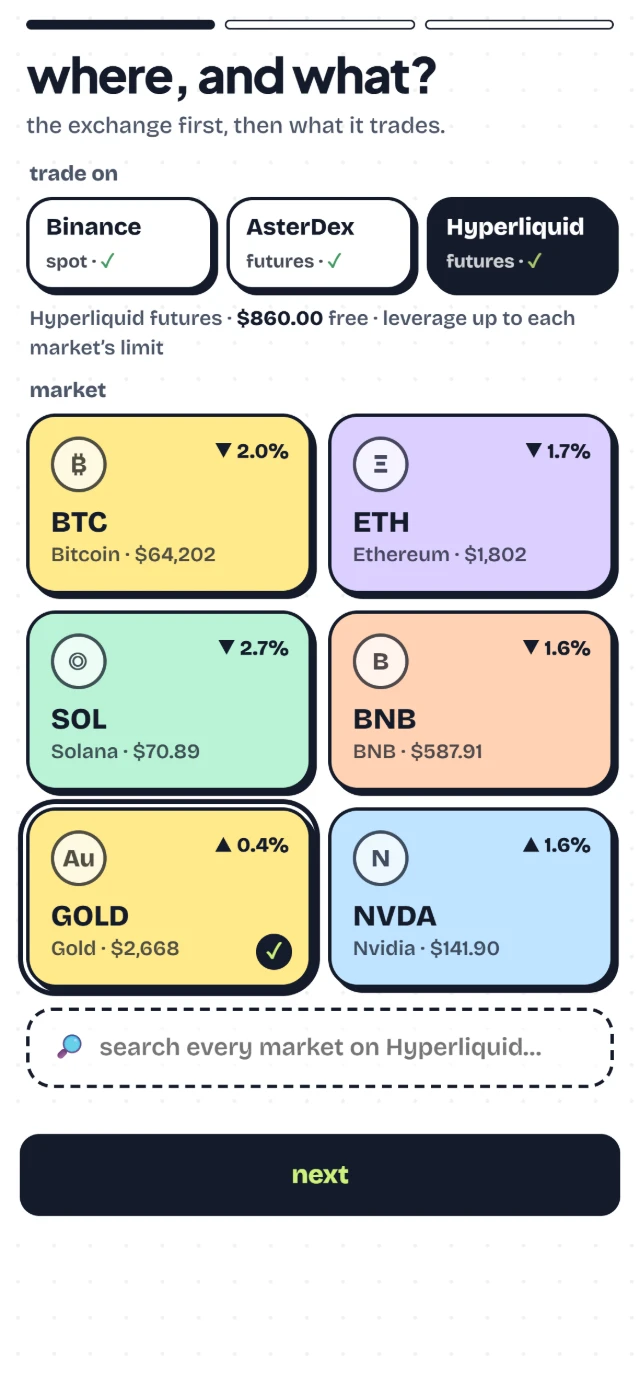
Bitcoin, Ether, Solana and hundreds more, trading around the clock.
Hundreds of coinsOn all three exchanges

You set the rules. Your agents watch the charts.
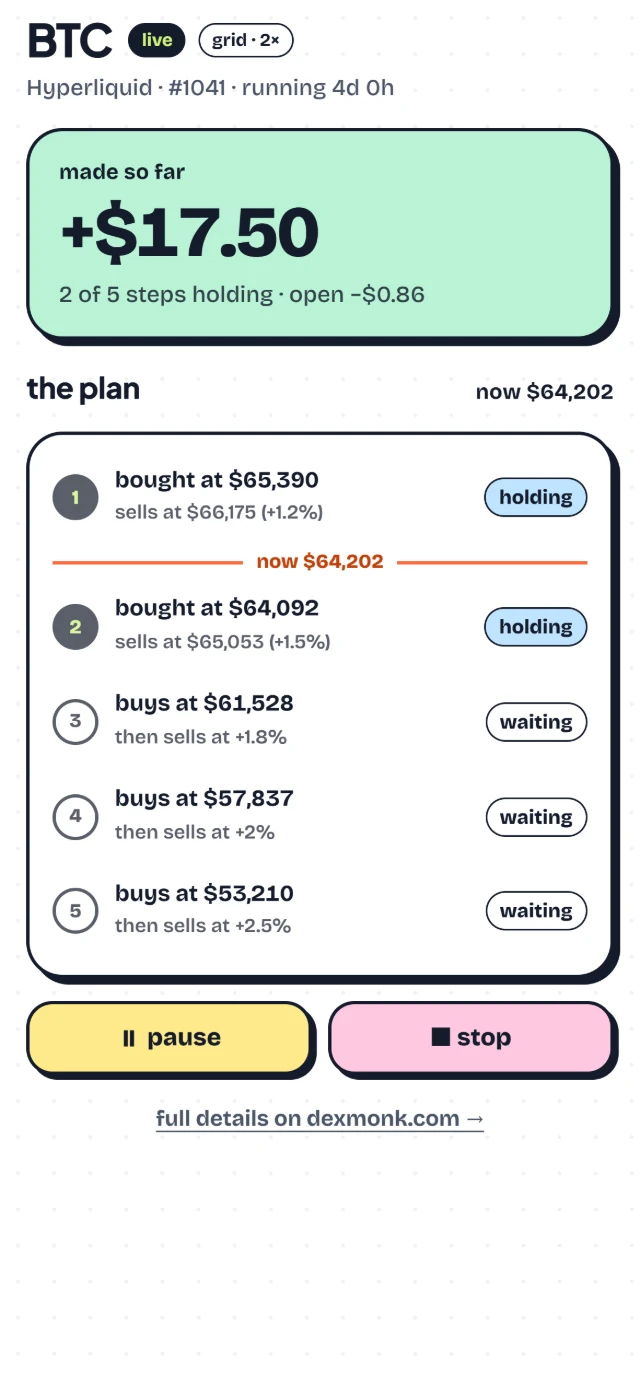
Your range is split into levels. Each dip to a level buys, each rise to the next level sells, over and over while price stays in range.
9 buys · 9 sells · 6 levels
Decentralized exchanges such as Hyperliquid and AsterDex now list gold, stocks, indices and currencies on-chain, right next to Bitcoin. DexMonk is the technology on top: it runs your bots on those exchanges, from your own wallet, so a grid on gold or Tesla works exactly like one on BTC.
Bitcoin, Ether, Solana and hundreds more, trading around the clock.
Gold, silver, platinum, copper, crude oil and natural gas.
Tesla, Nvidia, Apple, Microsoft and 100+ more, priced in dollars.
S&P 500, Nasdaq 100, Nikkei 225, KOSPI 200: a whole market in one trade.
The euro and the yen against the dollar.
Every DexMonk bot works on every one of these markets. Pick the market when you start the bot.Listings checked 15 Nov 2026

Two ways in. Let MonkiAI pick the bot, or say your own rule in plain words and see how it would have done.
No made-up confidence scores.
Which bot for BTC-USDC?
15m1h4hLong Grid
7 levels · 0.8% apart · 3 of 4 agree



DexMonk, inside the Telegram app you already have. Start a bot, get a message when it trades, stop it from anywhere.

nothing to install · same account as dexmonk.com · funds stay on your exchange
A DEX, a decentralized exchange, runs on a blockchain instead of inside a company. Switch sides to see where your money goes.
 HyperliquidLive
 AsterDexLive
 BinanceLive · CEX
 UniswapComing soon
 PancakeSwapComing soon
 RaydiumComing soon
 AerodromeComing soon
 SushiSwapComing soon
 Trader JoeComing soon
Live venues are fully supported today. Coming-soon venues are on the roadmap; dates are not confirmed yet.
No. Your money stays in your own exchange account the whole time. DexMonk connects with permission to trade only: it can place and cancel orders, but it can never withdraw.
Hyperliquid, AsterDex and Binance today. Uniswap, PancakeSwap, Raydium, Aerodrome, SushiSwap and Trader Joe are on the roadmap, with no dates confirmed yet.
There is no subscription. On Hyperliquid a fee of 0.01% is added to each order your bots place, which you approve once from your wallet. Bots on Binance carry no DexMonk fee, and neither do bots on AsterDex today, where the same fee is planned.
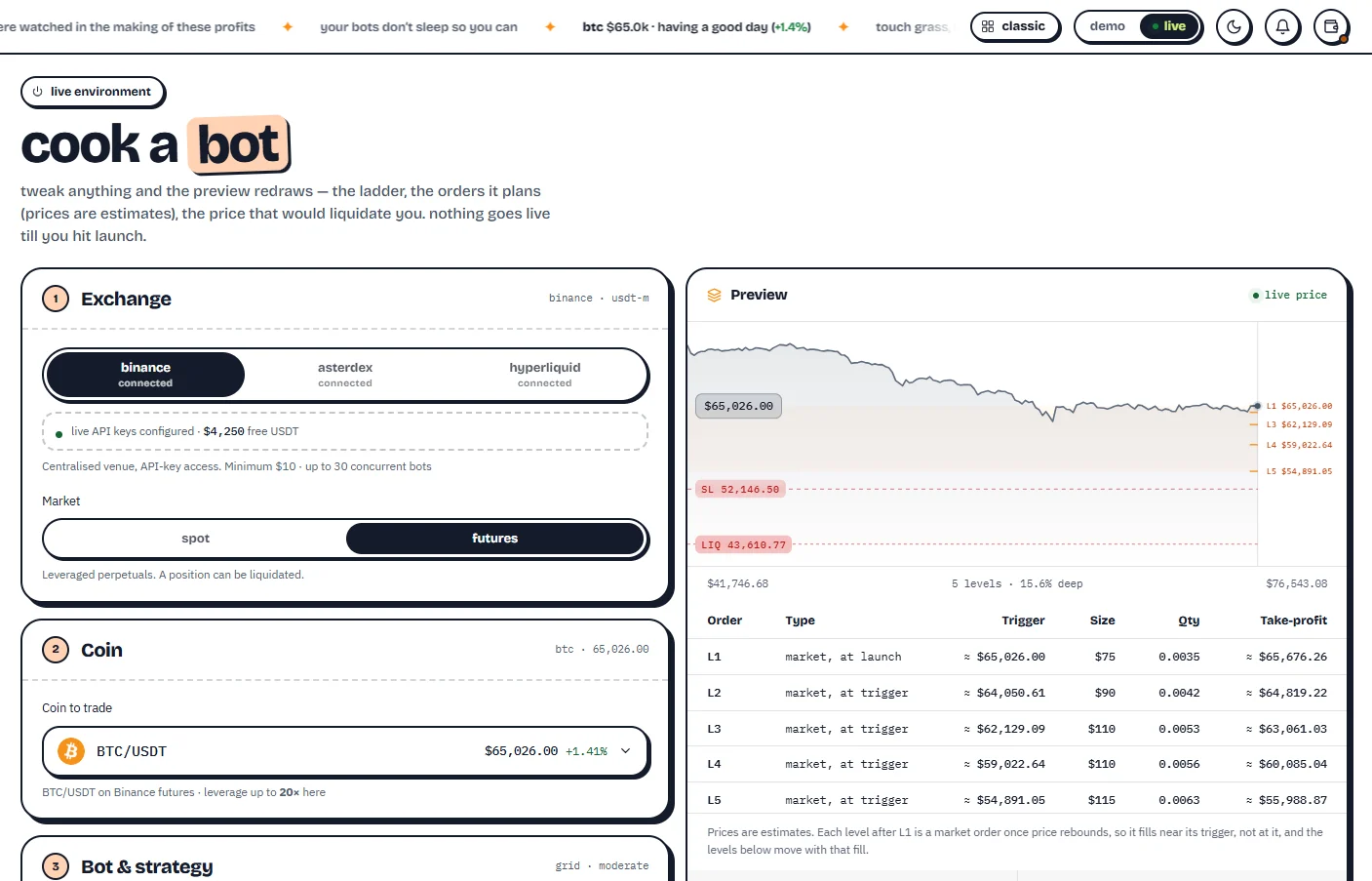
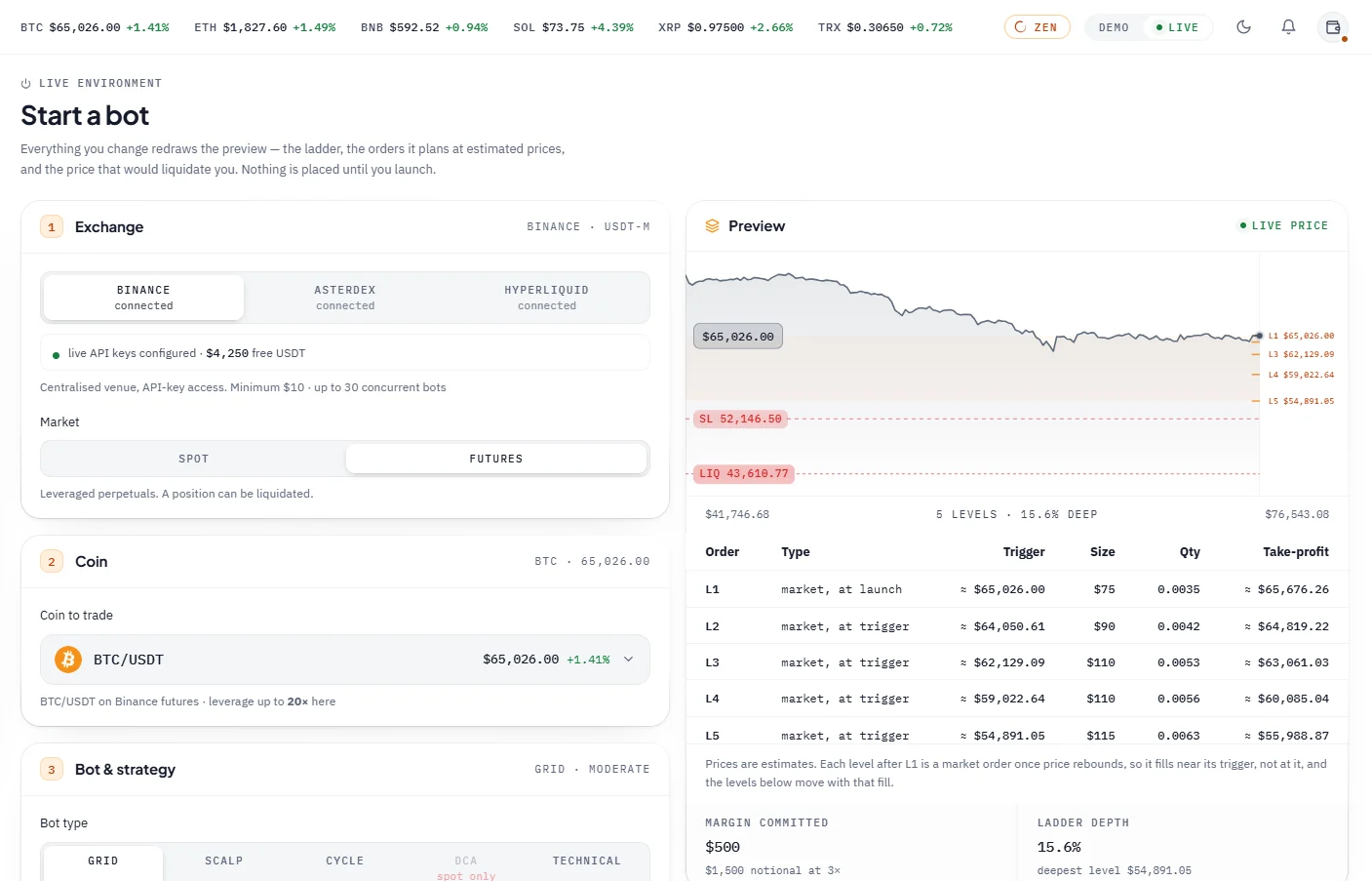
No. There is no code to write: pick a strategy, or let MonkiAI suggest one for the market, and the launch screen previews every order your bot plans to place, at estimated prices, before anything goes live.
Yes. Binance has a demo mode, so you can watch a bot work on test funds first. Hyperliquid runs live only, and AsterDex runs live only on DexMonk too — its test network has no safe way to get test funds. On either, you can start small.
Yes. Pause or stop any bot from your dashboard at any time, and your funds stay in your exchange account throughout.
Reading and spot or futures trading, depending on which markets you want to use. Nothing else. Do not enable withdrawals — DexMonk does not use that permission and does not ask for it.
You can revoke the key from your Binance account at any time, which stops every bot immediately without needing DexMonk to cooperate.
Yes. Every strategy here places real orders in a real market, and a market can move against any set of rules. On futures a leveraged position can be liquidated. Nothing on this platform removes that risk, and no setting makes a strategy safe.
What the software does is execute exactly the rules you wrote, report what actually happened including fees and funding, and refuse to invent results. It does not reduce market risk.
No, not for a Binance account. You can sign up with an email address and a six-digit code — no password and no wallet — and trade spot or futures on Binance straight away.
A wallet is required for decentralised venues, because AsterDex and Hyperliquid authorise trading by wallet signature and there is no email equivalent. You can link one later from Settings without losing anything you have already set up.
Two ways, both passwordless. Connect a wallet and sign a plain-text message — a signature, not a transaction, so there is no gas and no approval. Or enter your email address and the six-digit code sent to it.
Both open the same account. If you sign in by email on an account that already has a verified email, you get that existing account rather than a second one.
A grid bot divides a price range into levels and places an order at each one, so it buys as price falls and sells as price rises back through those levels. It profits from movement inside a range rather than from a directional call.
DexMonk adds a second condition at every step. A level does not fill the moment price reaches it: the level arms, the engine tracks how far price continues, and it fills only after price rebounds by a set amount. That is the difference between buying a bounce and buying a falling knife. On a grid, exits work the same way in reverse: a target arms, and the sell goes out once price pulls back from the peak, never below the target itself. A scalp bot instead closes its whole position at market as soon as its one target, measured from the average entry, is reached.
No, and it will not. Nothing here forecasts price. The MonkiAI feature reads published indicators — trend, momentum, volume, volatility — and reports what they currently say, including how many of them disagree. It frequently concludes that you should not open a bot at all.
A tool that claimed to predict price would be making a promise it could not keep, so the product refuses to make it.
No. A take-profit is held back if the price it would execute at is below the level that covers your entry plus the round-trip fees. The position stays open and waits for its target again.
This applies to take-profit only. A stop loss, a time-based exit or a trend reversal always executes, because the whole purpose of a protective exit is to act when the trade has gone wrong.
The bot reports that it did nothing, and says so plainly rather than quietly showing a flat line. A strategy that produced no fills is a real result and it is presented as one.
For indicator-based strategies the first run is a dry run by default: it records every entry and exit it would have taken, without placing an order, so you can see whether the rules fire before any money is committed.
Three concurrently on Binance, and ten on each decentralised venue, AsterDex and Hyperliquid. The caps are per venue, so all three can be used at once.
The limits exist because each running bot consumes a share of the request budget an exchange grants per connection, which is a shared resource rather than an upsell.
It depends on the venue's own minimum order size: about 10 USDT per order on Binance, about 5 USDT on AsterDex and about 10 USDC on Hyperliquid. A laddered strategy splits your capital across several orders, so the total needs to be large enough that every level still clears that minimum.
DexMonk checks this before launch and tells you if a ladder would produce orders too small to be accepted, rather than letting it fail partway through.